

Advancing South-South Cooperation: China and Cambodia Join Forces to Combat Schistosomiasis


From May 5 to 11, 2026, a seven-member expert team led by Chief Expert Zhou Xiaonong from the National Institute of Parasitic Diseases, Chinese Center for Disease Control and Prevention (NIPD, China CDC) visited Cambodia to carry out workshops and field investigations on schistosomiasis elimination. The mission supported the full implementation of key outcomes from the fourth Lancang-Mekong Cooperation Leaders’ Meeting and the Lancang-Mekong Five-Year Action Plan (2023–2027), leveraging the China-Laos-Cambodia Accelerated Schistosomiasis Elimination Cooperation Project and the Lancang-Mekong Joint Laboratory Project, both funded by the Asia Cooperation Fund.
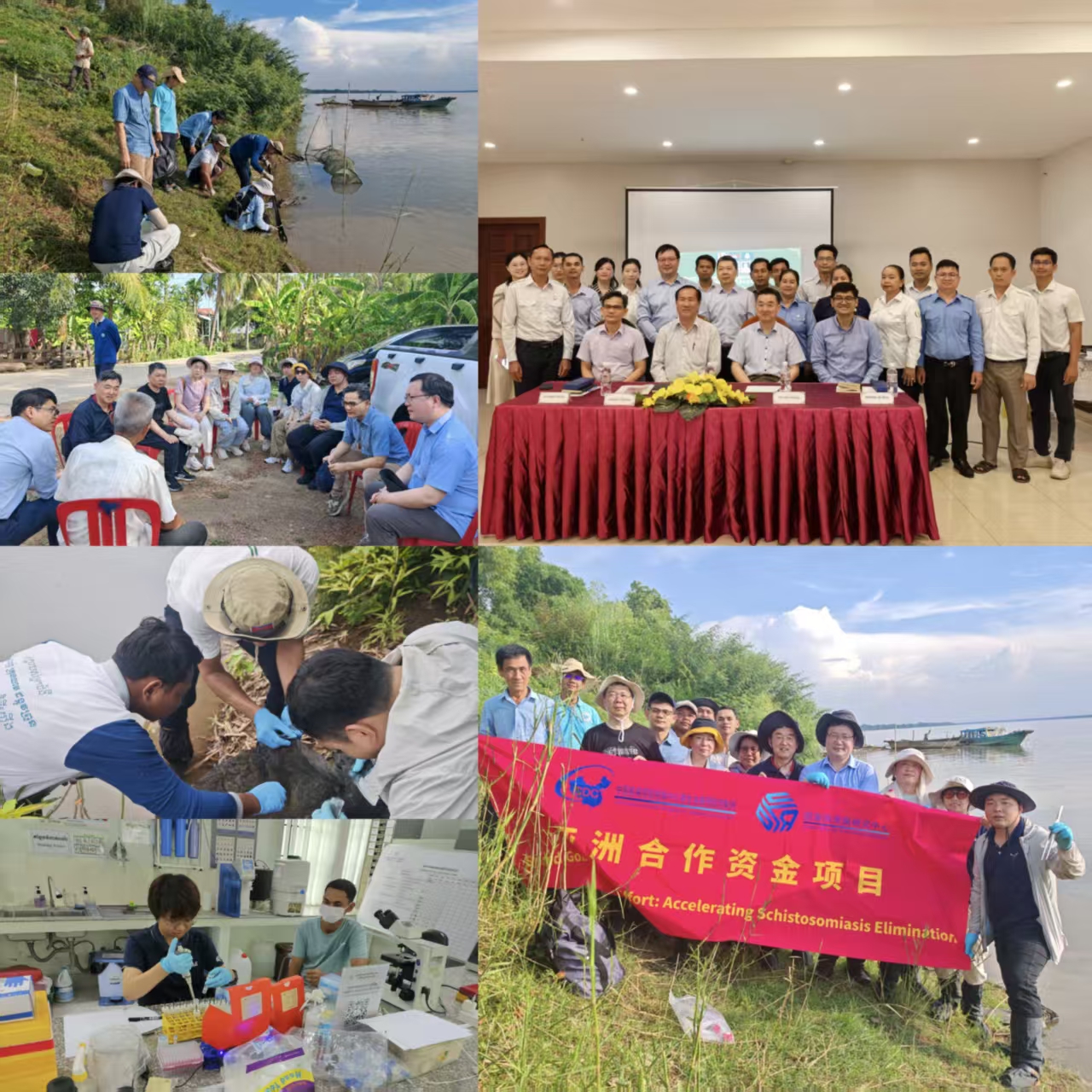
With the careful organization of the Cambodian National Center for Parasitology, Entomology and Malaria Control (CNM), the team visited three schistosomiasis-endemic villages in Kampong Cham Province. They conducted interviews with local residents, collected intermediate host snails and water samples, and held a workshop focused on schistosomiasis elimination to learn about Cambodia’s prevention and control strategies and the current epidemiological situation. After completing fieldwork, the experts returned to CNM to apply NIPD-developed qPCR and LAMP methods for DNA extraction and infection testing of snail samples, while water samples underwent environmental DNA (eDNA) testing.
This visit allowed the team to gain an in-depth understanding of Cambodia’s schistosomiasis situation, local prevention and control systems, diagnostic capacity, international cooperation, and the requirements for disease elimination. The experience enhanced the international perspective and technical capacity of China’s schistosomiasis control personnel, and laid a solid foundation for the smooth implementation of South-South cooperation projects and Asia-funded initiatives, supporting the joint effort to eliminate schistosomiasis as a public health problem across the Lancang-Mekong region.


京ICP备11024750号-1 京公网安备11011402013004号